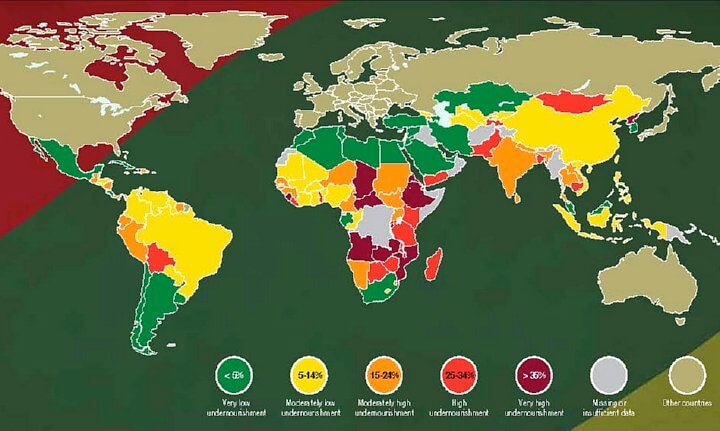
Where is the Hunger?

Prevalence of undernourishment in Developing Countries
Light Gray: Insufficient Data
Burgundy color: > 35%
Orange/Red: 25-34%
Yellow/Orange: 15-24%
Yellow: 5-14%
Green: < 5%
This map shows the prevalence of undernourishment in the total population of Developing Countries as of 2006-2008 (the most recent period for which complete data is available). Undernourishment exists when caloric intake is below the minimum dietary energy requirement (MDER). The MDER is the amount of energy needed for light activity and a minimum acceptable weight for attained height, and it varies by country and from year to year depending on the gender and age structure of the population. Map source: Food and Agriculture Organization of the United Nations. www.fao.org
Africa's population more than tripled during the second half of the 20th century, growing from 230 million to 811 million.The United Nations projects by 2050, that Sub-Saharan Africa’s population could be almost three times Europe’s and by 2100 might even be three-quarters of the size of Asia. Nigeria, Africa's most populous country at 158 million, is expected to grow to 730 million by century's end, making it larger than Europe's projected population of 675 million. By any measure, Africa is by far the fastest-growing continent. Sub-Saharan Africa’s current population, at 856m, is little more than Europe’s and a fifth of Asia’s. www.economist.com
The consumer who pays the largest percentage of their spending on food, is hit the hardest when it comes to food prices. See this interactive map (civileats.com) to find what percentage of each country's citizen's spending goes toward food. Indonesia 43, India 35, China 32%.
Share this page...

Become a Fan of Inspiration Green
Food Blog Additional Posts
Showing
1 -
20 of
31 Articles
New study shows stomach inflammation as well as uterus enlargement in GM-fed pigs.
Our federal dollars are being used to keep the American populace unhealthy and fat. Even though we seem to have a crisis on our hands, the U.S. government, corn lobbyists, trade associations and the Big Six (Monsanto, BASF, Bayer, Dow, DuPont and Syngenta) keep oiling the corn machine that was started in the mid-70s...a machine that needs to be reassessed.
Sixteen year old publishes scientific study showing fruit flies live longer and are more fertile if fed organic food versus conventional.
What to do with that overripe watermelon, the half eaten banana, the bruised peach.
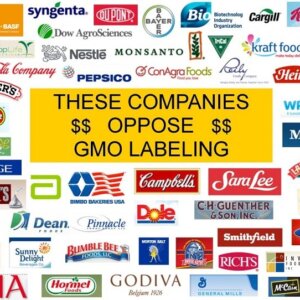
Organic (and some Natural) food brands owned by big corporations. And which and how much those large brands are donating to fight GMO labeling.
The definition of a whole food, is a natural food that has not been processed or has been refined as little as possible. Unfortunately, ultra-pasteurized, homogenized, grain-fed cow's milk is no longer a whole food. It is highly manipulated.
A breakdown of monies spent on food and the cost of food during the last thirty years.
World Hunger Map and population growth.
Clara Cannucciari - Learn how to make simple yet delicious dishes while listening to stories from the Great Depression.
Currently, unapproved use and abuse of antibiotics for food-intended animals is common practice. Sources say, close to 80 percent of all antibiotics sold in the U.S. are being fed or injected into cattle, pigs and poultry on industrial factory farms.
If you have the time, seems like a fun way to create healthy meals with your kids. Or, in the doldrums? Create a packed lunch just for yourself!
Nowadays whole milk is required to have a set 3.25 percent milkfat. Well, cows do not give milk at a set 3.25 percent milkfat... Learn how we get our milk so standardized.
Also of interest are MPCs. Milk Protein Concentrate is de-fatted, ultra-pasteurizated, ultrahomogenized, ultrafiltrated (UF), unregulated, powdered skimmed milk. Many manufacturers are using MPCs in their dairy products instead of real milk. Why? Because MPCs are a cheap and easy way to add a filling, stable protein into a product. Although MPCs do add protein, it is a very processed form. Are MPC's hurtful to the local food movement? Yes, as this dried, spoil resistant product takes less to transport than the fresh liquid milk, companies are choosing this processed powder over fresh milk.
Eating 'less' meat and dairy is the best way to reduce emissions. But know that, less dense cheeses produce fewer greenhouse gases since they take less milk to produce. Cottage cheese, ricotta, cream cheese, part-skim or fresh mozzarella, gouda, feta, muenster and non-fat yogurt are all more earth-friendly choices, especially if organic.
A new study published in the New England Journal of Medicine has found a correlation between certain foods and weight gain. And a new study out of North Carolina says the average American now eats 570 more calories a day than in 1977...
There are so many different sugars now...one can barely keep up...here's a list of all the added sugars...
15 million pounds of eight synthetic food dyes are put into our foods each year....the FDA is finally taking notice....
Whatever you call it: bioengineered, transgenically engineered, genetically manipulated, genetically engineered and genetically modified. We don't know its long term affects.
A list of cans with and cans without BPA.
Urban Agriculture - Outside on the Ground and on the Roof. The food of the future will be local...we will push our strollers past it and be intimately connected with it...
Showing
1 -
20 of
31 Articles
Write a comment