
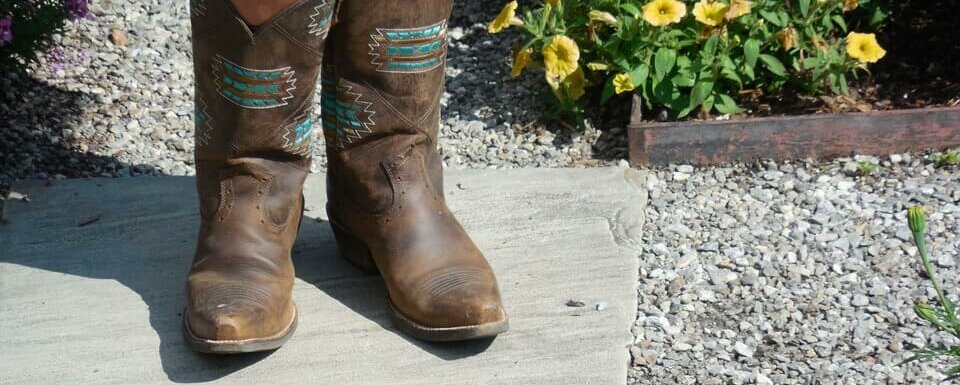
Have your feet ever turned blue, or black, or red from a pair of shoes or sandals?
Even Traditional Leather Tanning Was Toxic
If you have ever driven or walked near a leather tannery you know something foul is going on in there.
Tanning hides is an ancient practice and can be traced back as far as 7000 BC. It has been, and still is, a noxious process that has always been relegated to the outskirts of town, now it’s relegated to developing countries. Before tanning even takes place, the flesh and fat and hair need to be removed from the animal skin. Before chemicals and metals were used, ancient tanners would soak and then pound and scour the skin to remove flesh and fat. Next, the tanner would remove the hair fibers by soaking the skin in urine, or applying an alkaline lime mixture, or simply allowing the skin to putrefy for several months, then immersing it in a salt solution. After the hair fibers were loosened, the tanners scraped the hair off with a knife.
Once the hair was removed, the tanners would pound dung into the skin. Dog and pigeon dung was favored. Sometimes the dung was mixed with water in a large vat, and the prepared skins were kneaded for hours in the dung water until they became pliant. In cities, children were employed to gather dung and pee pots were ubiquitous street side. What an occupation!
After cleaning and kneading, the hides were tanned to soften them, preserve them, and make them water resistant. Skins are stretched on frames and soaked for several weeks in vats of increasing concentrations of tannin. Tannin is a plant compound found throughout the plant kingdom. In the tree, tannin is what protects the bark from fire, bugs and bacteria. Tannin found in specific tree bark, such as oak or chestnut bark, is the choice of tanners. That was the old days.
Modern Leather Tanning Requires Harsh Chemicals
Nowadays, 80-85 percent of tanned leathers are processed using chromium. And due to the tanning businesses’ disliked odors and waste, leather processing is often located in developing countries where environmental restrictions are lax. Currently, leather shoes are soaked in a chemical cocktail prior to appearing on your feet, and can be hazardous during the whole life cycle of the shoe.
A study done by the Swedish Society for Nature Conservation tested twenty-one pairs of brand-name shoes manufactured in various countries. They were analyzed for a number of metals and organic compounds. The metals analyzed in the study were arsenic, cadmium, chromium, cobalt, copper, lead, mercury, nickel, and zinc. High levels of trivalent chromium were found in all the shoes. All but one shoe, contained high levels of mercury. All of the other metals were found in varying degrees in all of the shoes.

www.naturskyddsforeningen.se
Also found were organic compounds either used for tanning, dying or preserving the leather.
Chlorinated phenols (biocide), ortho-phenylphenol (fungicide, anti-bacterial agent, preservative), 2,4,6-tribromphenol (fungicide, bactericide, flame retardant), chlorinated paraffins (de-fatting, re-fatting), dimethylfumarate (preservative), formaldehyde (preservative) were just some of the compounds tested and found in the shoes. Two of the tested shoes contained azodyes (banned in many countries) and capable of forming carcinogenic amines.
The Toxins In Leather Tanning Hurt Us And The Environment
Many of these metals, dyes and organic compounds can easily cross the skin barrier if one perspires in one’s shoes. Blisters and cuts on the foot may enhance the uptake.
Not only should we worry about our feet, but when we landfill our leather products these toxins could leach into our drinking water. Incineration is no better, as many of these compounds when mixed with other organics, become even deadlier. Trivalent chromium may oxidize into carcinogenic hexavalent chromium. Combustion of halogenated compounds, such as chlorinated and brominated phenols, may result in formation of dioxins and furans. Metals are not destroyed upon incineration, but volatilized, and subsequently condense to form sub-micron metallic particles which easily become airborne. Even early on, mining of chromite ore for trivalent chromium produces waste containing the toxic hexavalent chromium. And of course, the copious, caustic wastewater resulting from the tanning process itself, has been a serious issue for many, many years.
Chromium tanned leather has a considerable impact on the environment. Yet, there are numerous quality alternatives to chromium tanned leather. But, due to the fact that our shoes are manufactured in developing countries with less stringent environmental restrictions, there is less impetus for change.
What You Can Do
- If you go sock free on a hot summer day, remember your perspiration is mixing with chemical dyes, suspected carcinogens and heavy metals such as mercury, lead and arsenic and that mix could just possibly be re-absorbed through your skin and into your feet!
- Use your shoes as long as possible before landfilling.
- Buy eco-labelled shoes.
- Buy eco-vegan shoes.
- Ask for chromium-free leather.
- Write your Environmental Protection Agency to demand legislation that prohibits hazardous chemicals in consumer products.
- Most Of All: Buy Sustainable Shoes
More Information About Leather Tanning
‘Bad Shoes Stink’ Swedish Society for Nature Conservation www.naturskyddsforeningen.se
Leather Shoes spread environmental toxicants www.naturskyddsforeningen.se
Wikipedia-Tanning: en.wikipedia.org





































this information is so interesting, my eyes and ears are now open… lets protect ourselves, other earthlings and our enviroment…small changes.. BIG STEPS….peace and love to you all x
Interesting information about the toxic metals in leather footwear. I’ve have been wearing leather footwear without socks for the past three years, mainly in the summer months, until today I’ll have to rethink what I wear. I have on pair shoes that the insole is dyed black and therefore, makes the soles of my feet black. I don’t really wear them too much. I’ve been wearing leather clogs also. I should wear socks since my perspiration level can get the leather quite damp when the temp are hot.
Hi; I think a few words in this sentence are missing. You might want to fix it. Thanks for the article, very interesting…here’s the sentence: ‘…If you do not wish your perspiration, which has been mixed with chemical dyes,…’
One of my providers told me about the toxic chemicals/plastics used in all shoes made in China.
Are there any shoes made in China that are considered ‘safe’ (such as BORN, Clark’s, etc.)?
Interesting story. I recently came across a new German babies’ and children’s shoe brand (Pololo) which uses only vegetable tanned leather for their shoes. They are also certified ‘Allergy friendly’ and follow sustainability principles. This might be an alternative!
I have been trying to find a eco-friendly, natural, green edge dressing for shoes.
Any suggestions would be greatly appreciated.
Best regards,
Sandy
Hi. Off topic, but was wondering if you had any information about whether the antibacterial footbeds in the Merrell Hollyleaf sandals are safe to wear. I don’t want to be subjected to more toxic chemicals. Cute sandals, but do not like the idea of any antibacterial substance being absorbed by my body.
Thanks.
I waer shoes on my head as well as smoke shoes, will this cause me to develope diseases like AIDS?
Cost effective, high quality Chromium free tanning is now possible also for shoe applications. Eastman’s Tanfor T chemistry is based on aluminum and organic acids. Test series of shoes in Tanfor T leather have been successfully manufactured at TopMan and Janita of Finland, and production is expected to start during 2015 also in some major European and Chinese tanneries. Contact FAS@taminco.com for more info.
Thank you for your very interesting article. I am sure your readers would have appreciated knowing which brands were tested. Would the manufacturers mind? I am sure they would but then who cares? Maybe being exposed will help some of these mfgs. realize that they may very well be responsible for many of the illnesses in this Country. I would pay an extra dollar or two for healthier shoes.
So who are they?
Hello and Good Day
I am Max, Marketing Manager with a reputable online marketing company based in India.
We can fairly quickly promote your website to the top of the search rankings with no long term contracts!
We can place your website on top of the Natural Listings on Google, Yahoo and MSN. Our Search Engine Optimization team delivers more top rankings than anyone else and we can prove it. We do not use ‘link farms’ or ‘black hat’ methods that Google and the other search engines frown upon and can use to de-list or ban your site. The techniques are proprietary, involving some valuable closely held trade secrets. Our prices are less than half of what other companies charge.
We would be happy to send you a proposal using the top search phrases for your area of expertise. Please contact me at your convenience so we can start saving you some money.
In order for us to respond to your request for information, please include your company’s website address (mandatory) and or phone number.
So let me know if you would like me to mail you more details or schedule a call. We’ll be pleased to serve you.
I look forward to your mail.
Thanks and Regards
Max williams
I wore some new shoes for a couple of weeks. Then I had a massive problem, first a rash across the top of the foot. Then very, very rapidly blisters on every single toe – on top, underneath, at the sides between toes, across the top of the foot where the toes join (and elsewhere. I thought I had a new and very rapid type of tinea until a friend advised of a previous case where contaminants had badly affected a person’s breathing and made a work space unuseable when unpacking a box of shoes, until removed. It turns out the problem may be worse for imported shoes where additional treatment is required to avoid introducing foreign diseases (Australia). Massive expense treating tinea, couldn’t walk for days. Not impressed with the she retailer.
Any recomendations for shoes other than leather, that contain no heavy metals?
How can Chromium in leather shoes effect my feet?
Interesting article. While I’m a strong advocate for vegetable tanned leather, I have never had any allergic reactions to any type of tanned leather. I have, however, experienced tiny painful blisters on my feet after wearing synthetic leather shoes. Athletes foot is also an issue for me if I wear the synthetics.
I had a terrible time when I was wearing my cowboy boots and working on my boat trailer on a hot day in July 2022 my feet began to sweat pretty good t foot looked like it had a chemical burn .It was itching real bad and caused my foot to swell up so I went to the emergency room . The doc said it was a fungus he was wrong it was a chemical burn from my boots when it started to get better large peeling occurred