
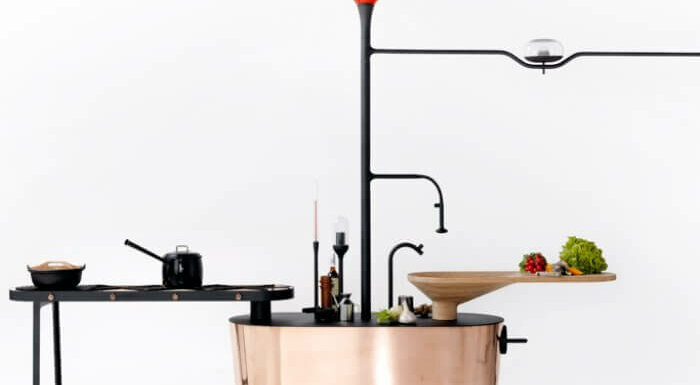
“Energy-saving light bulbs will only take us so far. We need to push ourselves to rethink domestic appliances entirely, to rethink how homes consume energy, and how entire communities can pool resources” says Clive van Heerden, Senior Director of Design-led Innovation at Philips Design. Philips believes the solution is likely to come from biological processes, which are less energy-consuming and non-polluting. We need to go back to nature in order to move forward. The Microbial Home is a proposal for an integrated cyclical ecosystem where each function’s output is another’s input. In this project the home has been viewed as a biological machine to filter, process and recycle what we conventionally think of as waste – sewage, effluent, garbage and waste water.
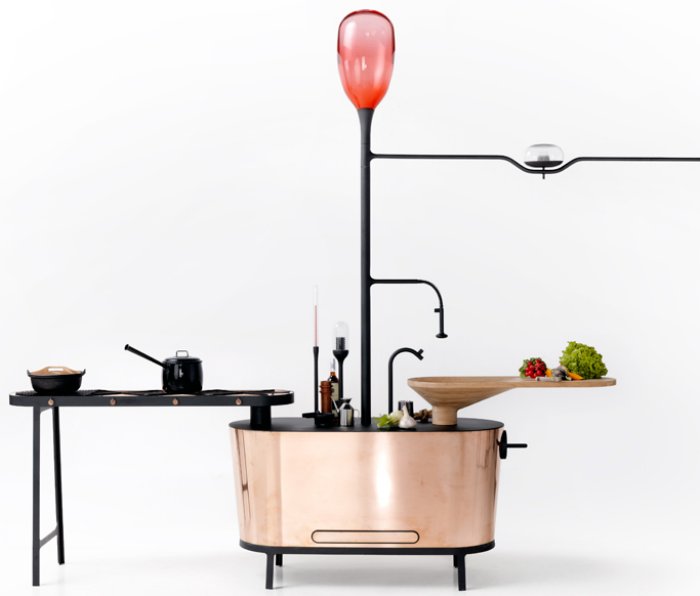
The central hub in the Microbial Home system is a repositionable kitchen island, including a chopping surface with vegetable waste grinder, a gas cooking range, a glass tank that shows energy reserves and glass elements showing pressure, volume and readiness of compost sludge. It consists of a methane digester, which converts bathroom waste solids and vegetable trimmings into methane gas that is used to power a series of functions. The gas from the methane digester is fed to a cooking range and gas mantle lights. ‘Bio-gas’ is produced by developing a culture of suitable bacteria living on organic waste material from the home. The gas the bacteria generate is collected and burnt. This arrangement is called a methane digester and it has been used in various configurations for centuries. The gas from the methane digester in the Microbial Home is fed to a cooking range and gas mantle lights. Water pipes are preheated by the digester and channeled to other components in the Microbial Home system.
Chopping surface with vegetable waste grinder. Materials used in the design are copper, cast iron, glass and bamboo.

Technological development has enabled us to mimic nature’s processes. Now, all that is lacking is a collective change in consciousness to take us into a Biological Age where by-products are no longer waste but fuel for other systems.
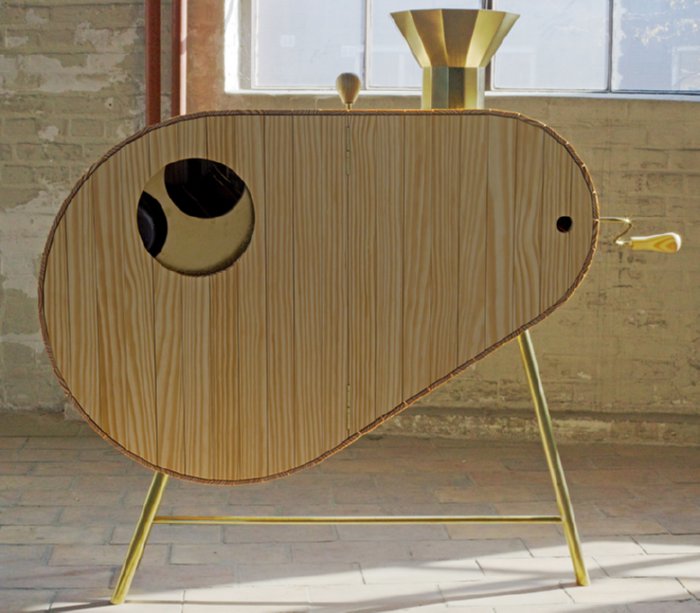
The paternoster domestic plastic waste up-cycler uses mycelium to break down plastic packaging waste. The waste up-cycler concept utilizes the properties of fungi that have powerful enzymes and decomposing power. A mycelium attached to plastic, has the ability to decompose and metabolize plastic. Provided the inks on the plastic did not contain toxic heavy metals, this mycelium could in theory generate edible mushrooms.
In this concept the plastics are ground into small chips and mixed with a fungal starter culture in a glass canister. A hand-cranked conveyor moves the canisters along a circuit within a dark cavity. Each week plastic grounds are mixed with mycelium. It takes several weeks to break down the plastic or other waste material. At late stages in the cycle the contents are exposed to daylight (via an aperture) and air allowing the mycelium to sprout mushroom fruit, ready to eat. The decomposing waste can be molded into shapes.
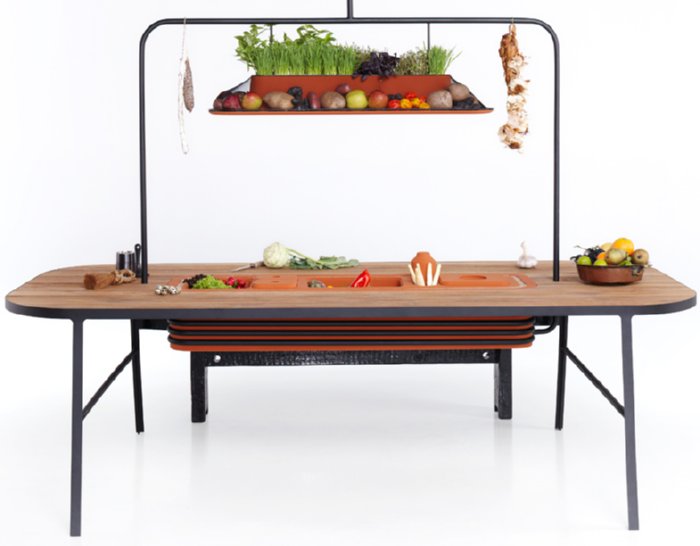
The larder consists of an evaporative cooler and vegetable storage system built into a dining table. The home of the future will need to accommodate a much greater proportion of local and home-grown food.
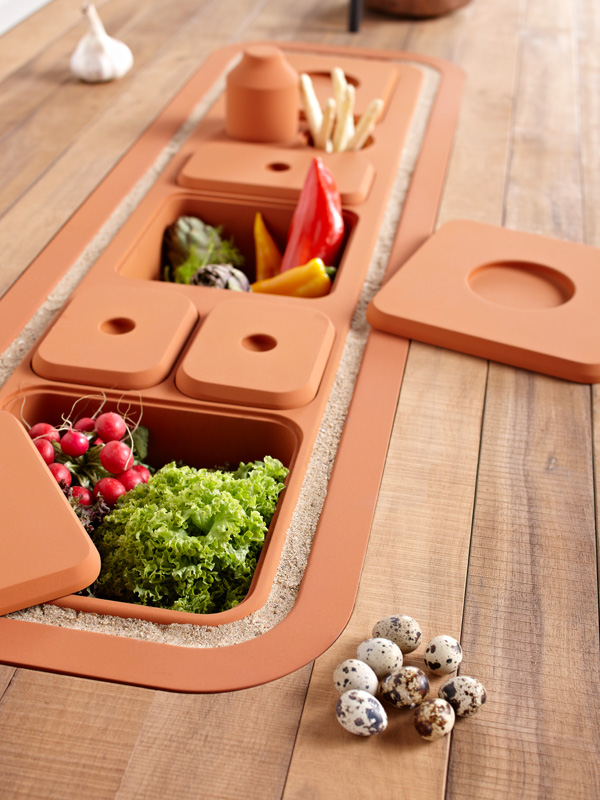
The larder revives the ritual of preparing food together around the dining table. With a twin-walled terra cotta evaporative cooler at its center, the compartments and chambers vary in wall thicknesses and volumes and are designed to keep different types of food at different optimal temperatures.
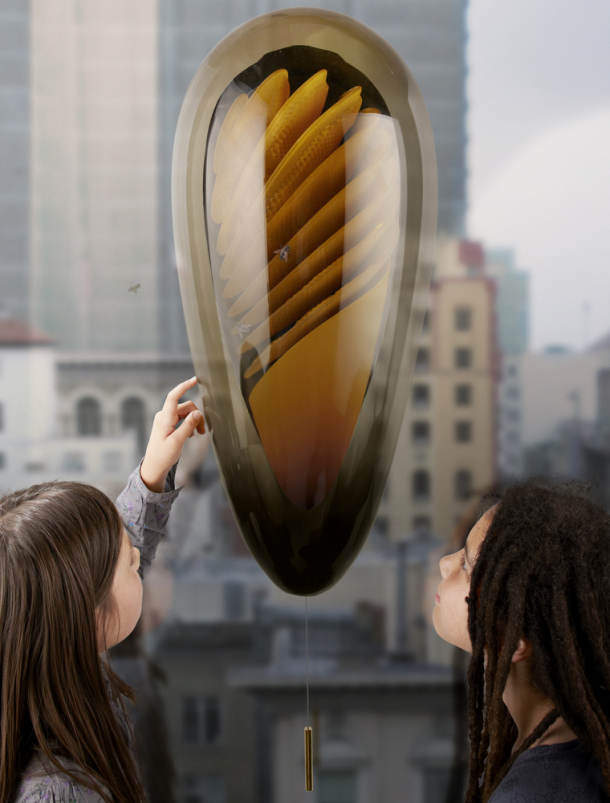
Urban bee-hive. The glass shell filters light to let through the orange wavelength which bees use for sight. The design prevents worry that the hive would freeze during subzero nights.
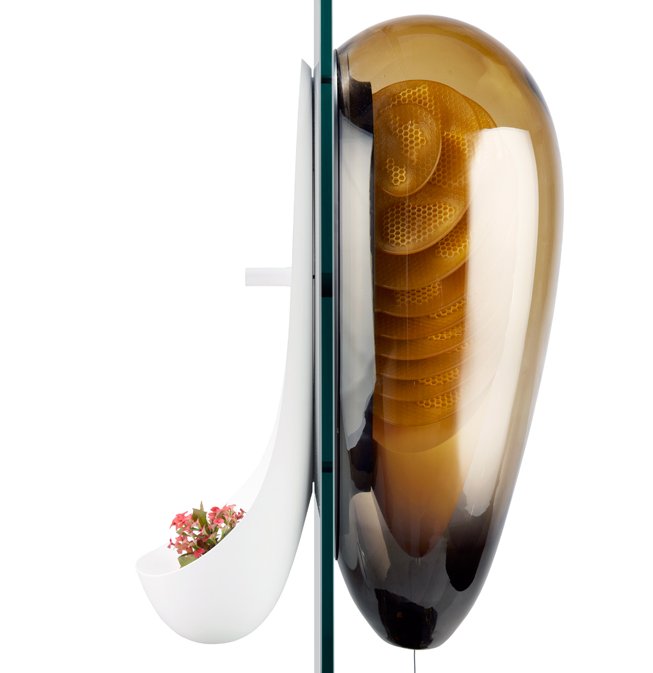
The urban beehive consists of an outside flower pot with a bee entryway above it. The inside glass container has honeycomb frames for the bees to build their wax cells on. A pull on the bottom of the hive is a smoke actuator that lets you calm the bees down before you collect some honey.
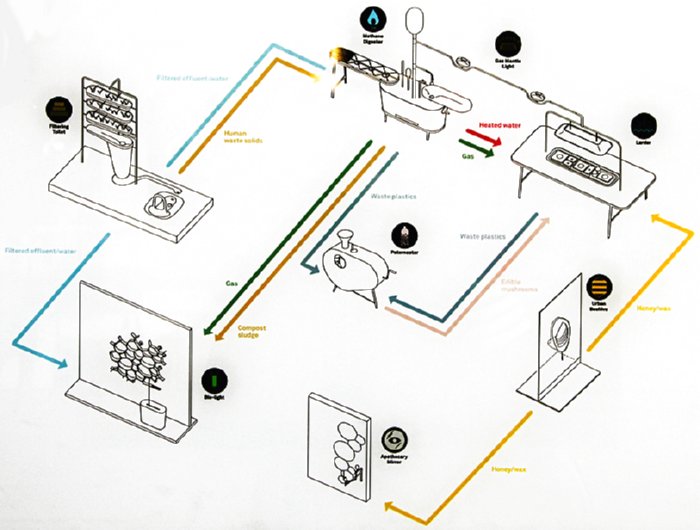
An integrated cyclical ecosystem where each function’s output is another’s input. We view the home as a biological machine to filter, process and recycle what we conventionally think of as waste – sewage, effluent, garbage, waste water. Research suggests that we should move closer to nature and challenges the wisdom of annihilating the bacteria that surround us.
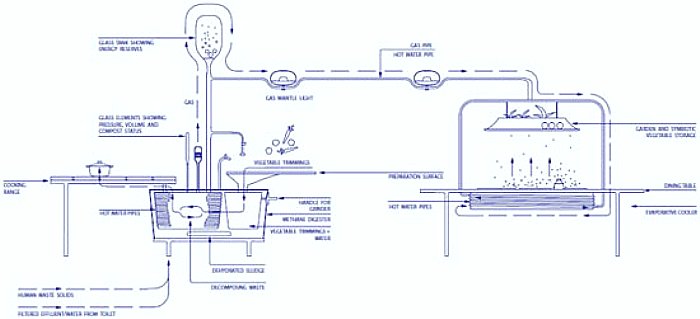
In the home of the future we will have to rethink our own waste and convert it into a usable asset.
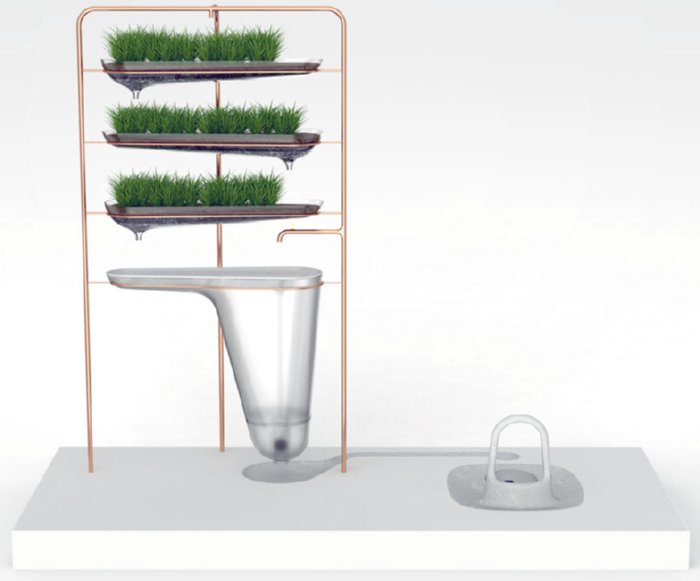
A waste separating squatting toilet filters urine while channelling excreta to a methane digester in the Microbial Home system. The filter array, comprised of charcoal, sand and ceramic filters, supports a range of plants to clean the urine. The system is designed to show the energy value in human waste and raise awareness about wasting water. It draws attention to the necessary systemic shift from utility dependent sanitation systems to regenerative localized solutions that see waste as a necessary part of a domestic eco-system.
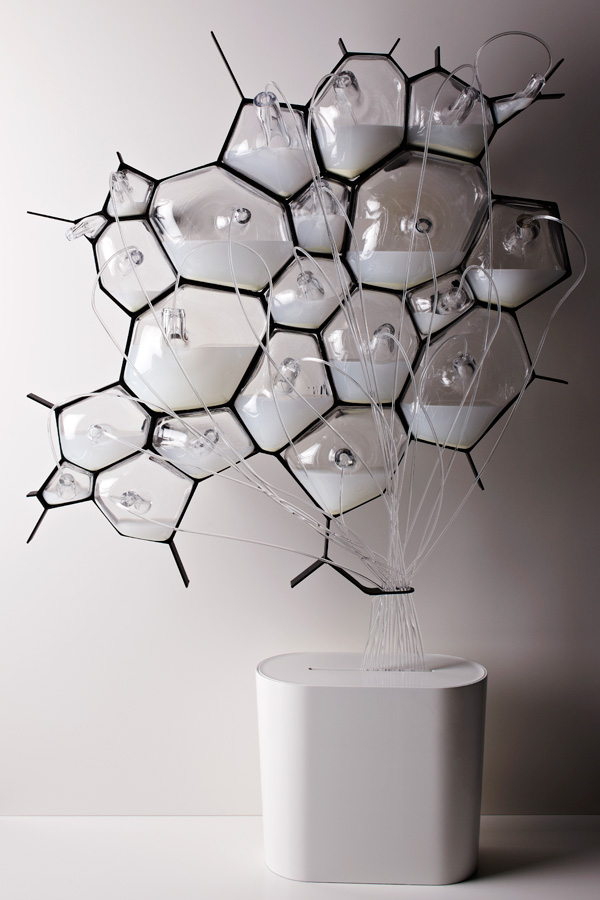
The bio-light concept explores the use of bioluminescent bacteria, which are fed with methane and composted material (drawn from the methane digester in the Microbial Home system). Alternatively the cellular light array can be filled with fluorescent proteins that emit different frequencies of light. Each cell is connected via silicon tubes to the food source, (which is drawn from a reservoir at the base) creating a closed loop system for the living material.
Related Post: Missions Kitchens
Luminescence is the phenomenon where light is produced at low temperatures, as opposed to incandescence, where light is generated as a result of high heat. Bioluminescent organisms produce an enzyme, luciferase, which interacts with a particular type of light-emitting molecule called a luciferin.
Kudos to Philips – more, please!
All info and images: www.design.philips.com





















When I had my warehouse space south of Market in San Francisco, we never imagined quite hard enouth….. I love it that these are all working models, as shown by the photos in a loft space – not gedanksexperimenten.
The terra-cotta cooler is quite elegant!. A goodly amount of molds and casting forms are not illustrated, but were needed to make the units. The sand-bed explains how it works – just add water.
The beehive structure is very interesting. The disk-shaped wax comb-frames are entirely different from any I have seen in any other modern beehives – for the past two centuries, they’ve always been rectangular. (Beekeepers provide pressed-wax frames for bees to build with; otherwise, bees use about 10 lbs of honey to make one lb of wax, cutting way into honey yield.) The children are looking at a working hive – the disk frames have been built out into full combs.
I’m not clear about how the ‘waste separating squatting toilet’ works… just where are you supposed to squat?
Does the ‘bio-light ‘ actualy work? I want to see it in action!
The ‘plastic waste up-cycler’ is somewhat obscure. Not putting down the idea, but important questions: Exactly what kinds of plastics can be digested, by what species of mycelium? What kind of mushrooms result? And, is is certain that the mushrooms grown on plastic are edible? What is the non-mushroom residue after wards, and how is it used?
Hi there Rashid,
Great comments! Learned something as to beehives from you, thanks. I can’t tell if they made an actual bio-light or just illumined the photos. See photos here: https://www.design.philips.com/philips/sites/philipsdesign/about/design/designportfolio/design_futures/design_probes/projects/microbial_home/bio_light.page
Again as to plastic up-cycler, Philips has not answered some of the questions you seek as to species of mycelium, what exactly results, really edible?, etc.. Good questions…
What an awesome kitchen. I’m definitely going to keep these ideas in mind next time i remodel!
I absolutely love it!!!!! I want one! It’s so inspiring to see that there may be possibilities to sustainable living other than just living on a field. This is definitely genius and must have taken months if not years to design! I’m in school as a Environmental Engineer and I hope that someday I can design systems like this.
Link at the end to Philips’ website doesn’t work…
Thanks for the heads up…
way to think people ,love the system ……
this is very inspirational
Right, Everyone is just lining up to get one of those squat toilets. lol
Plastic recycler: Decomposing the plastic means it can’t be reused, and despite their claims we don’t yet have plastic-eating fungi which produce edible fruiting bodies. If you want plastic to be ‘molded into shapes’ get a Filabot and turn it into feedstock for a 3D printer.
Larder: The cooler is incredibly energy- and water-inefficient and does not allow for extended storage, especially of things like milk, eggs or more perishable produce.
Beehive: I’ve talked to professional and enthusiastic amateur beekeepers about this design. The kindest expressions they come up with are ones of scorn. It’s not a real beehive. It’s an art-student’s cool design.
Biogas generator: A solid, mature technology. But the amount of gas you’d get from it is questionable.
Bio-lights: With high-efficiency LEDs becoming cheaper the amount of care and resources you’d have to put in in return for the light you’d get out probably aren’t worth it.
Toilet: Basic hygeine dictates keep food preparation away from defecation. That toilet had better not be in the kitchen
Sink: Wooden sinks are high-concept, high-priced and low-practicality.
When will these be available at IKEA??
Seriously? You have nothing good to say about this? Who are you to even have the right to call anyone out on any design flaws when you haven’t even seen it work with your own two eyes? And are we supposed to just take your word, some random internet person who could just be a global elitist trying to keep us from investing in something so potentially great and life/world changing. Seriously, I hold nothing you say credible because all you’ve shown is contempt for these designs. I really don’t care what you say, A. Nuran. I have some faith.
Though it may be a idea right now I think we do need to start thinking bigger and broader. I’m all for change just look at how we do things now, not good.
I’m a beekeeper, and cringe at the sight of that artsy ‘beehive’. Holding the hive at inside temperature is a surefire way to kill you bees, as they don’t enter hibernation. The built-in smoker is as smug as a plate with built-in spoon.
The evaporative cooler cannot stand in the middle of your room. It would saturate the air with water vapor, then stop working – and give you lots of mold on the walls.
There is no mycelium that can break down plastic – and if we had one, we would certainly encounter it in a full grown waste treatment facility, with bioreactors and filters and a crew of workers and scientists. Not a hand-cranked wooden contraption that sits in mom’s kitchen. Same to the methane digester – you don’t want to have one of these in your enclosed kitchen 🙂
You don’t solve problems by creating artsy nifty-looking kitchen interior and claim it will magically turn your waste into energy, while refrigerating your stuff and growing your food for free.
These concepts are awesome and give me hope that we can really turn around the destructive, wasteful and hopeless ways we interact with our environment. I pray I live to see the whole world utilizing the amazing systems you have devised!
Philips design is a lovely science fiction story about our future life that maybe (hopefully) come true.
And this is exactly what we need after years of depressing knowledge of our over consumption. Nobody has so far been able to give us appealing visions of a new sustainable future. So thank you Philips for giving us hope and direction.
It may not be a perfect working model that can perform the tasks to our satisfaction yet. But Rome was not build in one day. It seems to have got so much truth in it that it is worth to continue this development.
Bees do not hibernate. They go dormant in the northern climates because they cannot take the cold. In the south they are active year round. As for design, very cool, although I would push the idea that the bees can make their own comb, they don’t need us humans to help them that much. Love all the ideas and cannot wait for that future!
Mel, Yale found a mushroom in the Amazon a year or so ago that eats and decomposes plastics and can live in an anaerobic environment. Try having actual knowledge before tearing apart an article; especially one in which he states that the device could theoretically do something rather than be proven to do so…