Our Food Choices Affect the Climate


food affects climate

From the “Meat Eater’s Guide to Climate Change and Health


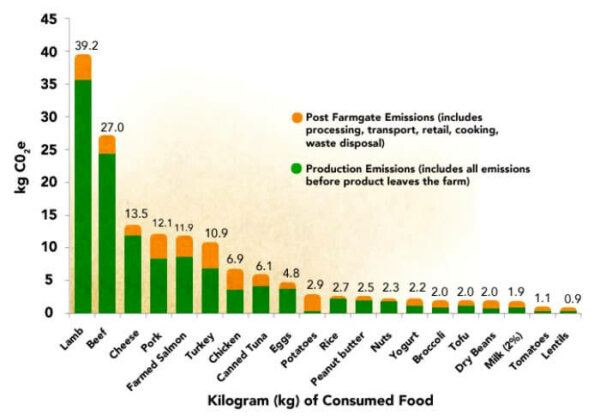
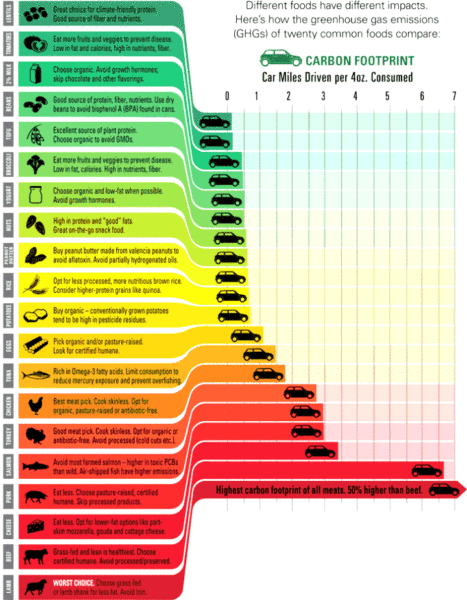
The Environmental Working Group's new report takes into account the full “cradle-to-grave” carbon footprint of each food item based on the greenhouse gas (GHG) emissions generated before and after the food leaves the farm, from the pesticides, fertilizer and water used to grow animal feed through the grazing, animal raising, processing, transportation, cooking and, finally, disposal of unused food.


Don't say 'Cheese'

The surprise for me is cheese!
Lamb, beef, cheese and pork generate the most greenhouse gases. They have the worst environmental impacts, because producing them requires the most resources – mainly chemical fertilizers, feed, fuel, pesticides and water – and pound for pound, they generate more polluting manure.

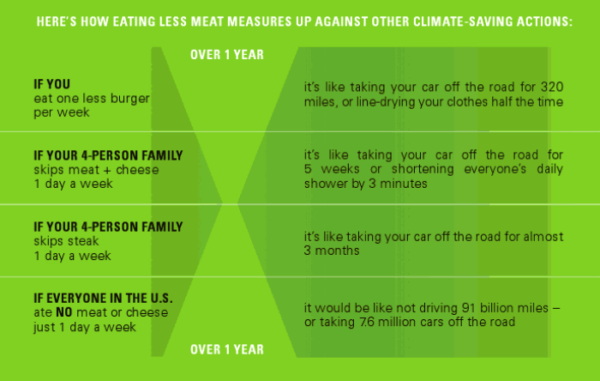
But the good news is that meat, eggs and dairy products (especially low-fat) that are certified organic, humane and/or grass-fed are generally much less environmentally damaging than conventional meat and dairy. Greenhouse gas emissions vary depending on the quantity of chemical fertilizers, fuel and other farming practices. Yet, although organic is better, eating 'less' meat and dense cheese is the best way to reduce emissions.

To ease the guilt of those of us who love cheese, the EWG notes that less dense cheeses produce fewer greenhouse gases since they take less milk to produce. Cottage cheese, ricotta, cream cheese, part-skim or fresh mozzarella, gouda, feta and muenster are all more earth-friendly choices, especially if organic.

After a bit of research it appears a dense cheese like cheddar uses 10 pounds of whole (3.25% fat) milk (8.5 lbs of milk = 1 gallon) to produce one pound of cheese.^ But a soft cheese like feta is pound for pound, one pound of milk gives one pound of cheese.

Organic low-fat milk and organic non-fat & low-fat yogurts are all climate friendly according to the EWG's research. Thank goodness they didn't analyse ice cream.


Full Lifecycle Greenhouse Gas Emissions from Common Proteins and Vegetables


Lamb, beef and cheese have the highest emissions because they come from ruminant animals that constantly generate methane through their digestive process. Plus, ruminants also require significantly more energy-intensive feed and generate more manure than poultry.


Summary: giving up the worst offenders is good for the climate, the environment, your health and the well being of animals (as less animals will be raised in factory farms).


To Note:

Farmed salmon has a high waste rate (44 percent is thrown away by retailers and consumers). And farmed salmon eat prepared fish meal which is energy-intensive to produce.

According to the EWG - 'Consumers throw out 40 percent of the fresh and frozen fish they buy, 12 percent of the chicken, 16 percent of the beef, 25 percent of the pork, and 31 percent of turkey is discarded at home or in restaurants. On average, retailers throw out about 5 percent of the meat they sell. Waste disposal accounts for roughly 22 percent of broccoli’s total emissions, 20 percent of tomatoes’ and 5 percent of potatoes’ - but home composting of vegetables can reduce emission numbers by 10%.'**

'The RDA for men ages 19-70 is 56 grams per day of protein, and the most recent National Health and Nutrition Examination Survey showed that men in this age group consumed almost twice this much on average: 88.3-109.2 grams per day (Fulgoni 2008). By contrast, only 1 percent of children and 4 percent of adults ate their recommended daily intake of fruits and vegetables (Kimmons 2009).'**


food affects climate


Share this page...
Become a Fan of Inspiration Green


Write a comment

  • Required fields are marked with *.

If you have trouble reading the code, click on the code itself to generate a new random code.
 
Fred
Posts: 3
Comment
Best meat
Reply #3 on : Fri April 19, 2013, 15:27:48
I'd be interested to know where rabbit fits on this scale. It would seem to be one of the most sustainable, climate-friendly and healthy sources of animal protein.
JM
Posts: 3
Comment
Re: Food Choices Affect the Climate
Reply #2 on : Tue January 01, 2013, 09:05:38
I find the rankings hard to swallow without more detail on how they were derived. Have read elsewhere that rice paddies produce more methane than cows, so how could it be ranked so low?
vicki johnson
Posts: 3
Comment
lamb as the worse for the environment
Reply #1 on : Sat January 21, 2012, 02:14:31
I don't agree that lamb is the worse for the environment when compared with the amount of methane produced by a much larger animal the cow > In Australia lamb is produced much more environmentally than beef or dairy products. Beef/dairy cows consume more grass/feed/water and produce much more waste. Sheep being small er animals consume much less feed, water and produce mush less waste. Your comparison are not right.
Food Blog Additional Posts
Showing 1 - 20 of 29 Articles
< Previous 12 Next >
Fruit Flies Live Longer on an Organic Diet
 
Sixteen year old publishes scientific study showing fruit flies live longer and are more fertile if fed organic food versus conventional.
Fruit for the Butterflies
 
What to do with that overripe watermelon, the half eaten banana, the bruised peach.
Food Companies Fighting GMO Labeling
 
Organic (and some Natural) food brands owned by big corporations. And which and how much those large brands are donating to fight GMO labeling.
Is Milk a Whole Food?
 
The definition of a whole food, is a natural food that has not been processed or has been refined as little as possible. Unfortunately, ultra-pasteurized, homogenized, grain-fed cow's milk is no longer a whole food. It is highly manipulated.
The Price of Food
 
A breakdown of monies spent on food and the cost of food during the last thirty years.
Where is the Hunger?
 
World Hunger Map and population growth.
Great Depression Cooking
 
Clara Cannucciari - Learn how to make simple yet delicious dishes while listening to stories from the Great Depression.
Antibiotic Chicks
 
Currently, unapproved use and abuse of antibiotics for food-intended animals is common practice. Sources say, close to 80 percent of all antibiotics sold in the U.S. are being fed or injected into cattle, pigs and poultry on industrial factory farms.
Bento Box Inspiration
 
If you have the time, seems like a fun way to create healthy meals with your kids. Or, in the doldrums? Create a packed lunch just for yourself!
Yak Milk in Your Cracker?
 
Nowadays whole milk is required to have a set 3.25 percent milkfat. Well, cows do not give milk at a set 3.25 percent milkfat... Learn how we get our milk so standardized. Also of interest are MPCs. Milk Protein Concentrate is de-fatted, ultra-pasteurizated, ultrahomogenized, ultrafiltrated (UF), unregulated, powdered skimmed milk. Many manufacturers are using MPCs in their dairy products instead of real milk. Why? Because MPCs are a cheap and easy way to add a filling, stable protein into a product. Although MPCs do add protein, it is a very processed form. Are MPC's hurtful to the local food movement? Yes, as this dried, spoil resistant product takes less to transport than the fresh liquid milk, companies are choosing this processed powder over fresh milk.
Food Choices Affect the Climate
 
Eating 'less' meat and dairy is the best way to reduce emissions. But know that, less dense cheeses produce fewer greenhouse gases since they take less milk to produce. Cottage cheese, ricotta, cream cheese, part-skim or fresh mozzarella, gouda, feta, muenster and non-fat yogurt are all more earth-friendly choices, especially if organic.
It's what you eat -- and how much
 
A new study published in the New England Journal of Medicine has found a correlation between certain foods and weight gain. And a new study out of North Carolina says the average American now eats 570 more calories a day than in 1977...
All the Different Sugars
 
There are so many different sugars now...one can barely keep up...here's a list of all the added sugars...
Best Veggie Burgers
 
Best Veggie Burgers
Food Dyes Linked to Behavioral Problems
 
15 million pounds of eight synthetic food dyes are put into our foods each year....the FDA is finally taking notice....
Genetically Modified Cartoons
 
Whatever you call it: bioengineered, transgenically engineered, genetically manipulated, genetically engineered and genetically modified. We don't know its long term affects.
Cans without BPA
 
A list of cans with and cans without BPA.
Urban Agriculture
 
Urban Agriculture - Outside on the Ground and on the Roof. The food of the future will be local...we will push our strollers past it and be intimately connected with it...
Solar Cookers
 
The three types of solar cookers explained...
What we do to Pumpkins
 
What we do to pumpkins...why have our customs evolved in this way? Abundance and humor? Pumpkin people and pumpkin creatures...
 
Showing 1 - 20 of 29 Articles
< Previous 12 Next >