
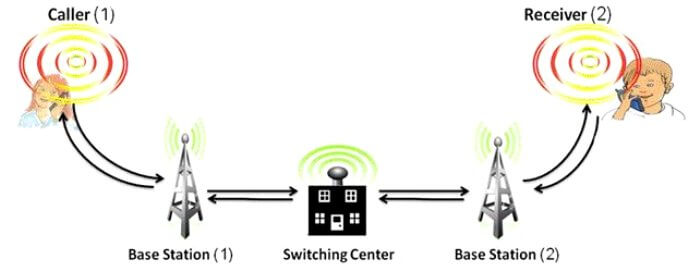
When you initiate a mobile call, your cell transmits to the closest base station (also called a cell tower). The base station then contacts the switching station, which figures out and keeps track of, the caller’s number and the receiver’s number. The switching station will then transmit the call to the base station closest to the receiver. The base station then sends a signal to the receiver of the call.
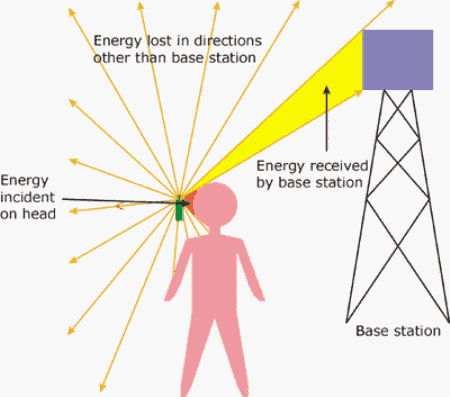
Most of the transmission signals are lost in space, as the signals are sent out 360 degrees from the cell’s antenna. Only a small percentage hit the tower.
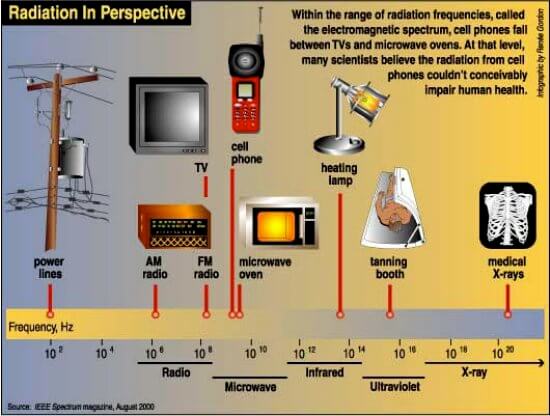
Cell phones use electromagnetic radiation in the microwave range. Put another way, cell phones use microwaves to transmit and receive information.
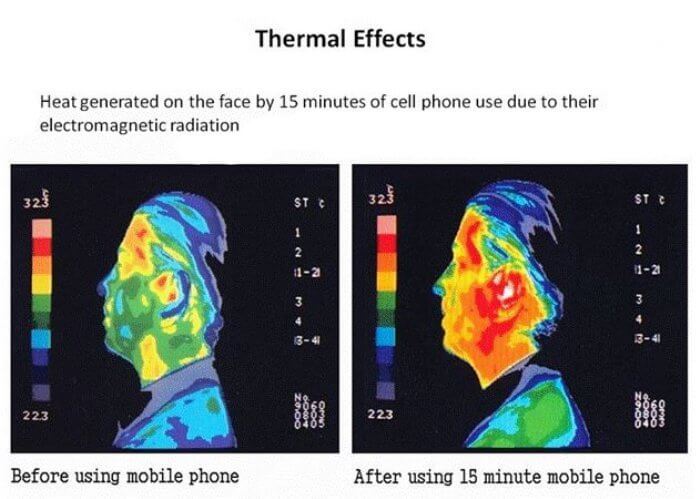
[library.thinkquest.org], www.fisherclinic.com, www.ncbi.nlm.nih.gov
The radiation and thermal effects you are exposed to, are directly related to the time you spend talking on your cell. When you know the conversation will be a long one, use a wired phone.
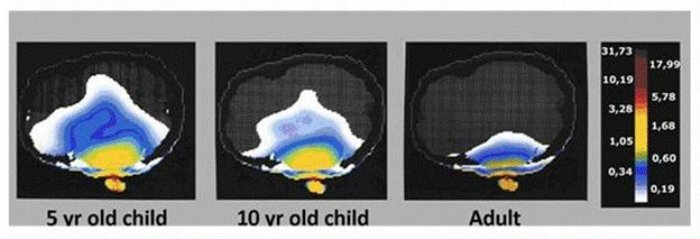
Dr Om Gandhi (University of Utah) shows how radiation penetrates the skull of an adult (25%), 10 year old (50%) and a 5 year old (75%). The younger the child the deeper the penetration due to the fact that their skulls are thinner and still developing. Bone marrow in a child’s skull absorbs 10 times more microwave radiation than does an adult.www.environmentalhealthtrust.org
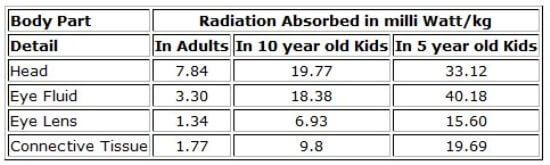
Dr Om Gandhi (University of Utah)
How To Reduce Your Exposure To Cell Phone Radiation
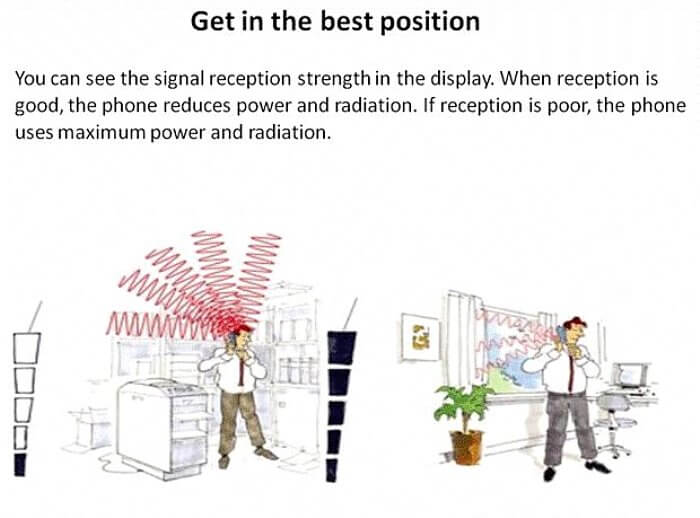
Radiation is strongest when the signal is very weak. In weak signal areas, the cell phone cranks up its power to connect to the base station. Keep this in mind in buildings as well as when traveling — as towers come in and out of range, you are being exposed to larger amounts of radiation. Also, if you are in a rural location, far from a cell tower, and your cell is constantly trying to connect, reconsider using your cell.

Your cell phone is a tiny transceiver: a combination transmitter and receiver. The radiation is strongest in transmition mode. Tilting the phone away from your ear as you speak will help reduce radiation zapping your head when the cell is transmitting to the tower.
Or —
Always hold the phone 2 inches from your ear and you will dramatically reduce the amount of radiation penetrating into your head.
Or —
Keep the phone at least a foot away from your body and use the speakerphone setting.
Or —
Use a headset. A wired headset may still transmit radiation through the wire – but it is at a reduced level. Best, is to purchase a ferrite bead, which is a clip you put on the wire of a headset. The bead absorbs the radiation and none reaches your head. You can find numerous ferrite beads on your computer cords, on the side they plug into the computer, the ferret beads are integrated into the cord and reduce static. Ferret beads are available at stores or online ($15 or less). Hollow tube earpieces reduce most radiation as well, but I have yet to find one that works well.
Or —
Use a Bluetooth earpiece, which still emits radiation, but some models reduce the radiation by 100 times. Some, emit much more radiation. Check the radiation levels on each Bluetooth carefully. Keeping in mind that although the radiation is much lower, the source is in your ear, and therefore really close to your brain. Due to the constant low radiation of the blue tooth, one should take it out of the ear when not in use.
Or —
Don’t talk, text.
Low-Radiation Phones
The FCC has set a SAR limit of 1.6 W/kg, averaged over a volume of 1 gram of tissue, for the head. The FCC ID number usually is shown somewhere on the case of the phone. Use that number and the FCC ID Search Form to learn more about your cell phone’s SAR limits.
CNET and the Environmental Working Group, have produced charts that show the amount of radiation produced by popular phones.
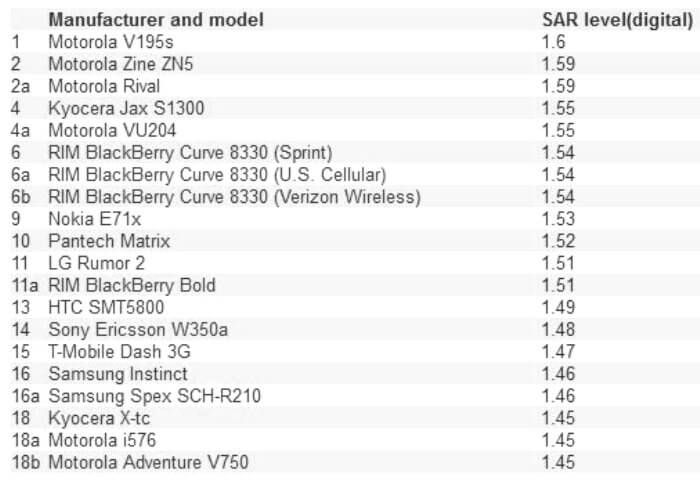
Be wary of radiation shields that claim to limit exposure to radiation. They may reduce the connection quality and therefore force the phone to transmit at higher power.
In May, 2011 the International Agency for Research on Cancer (IARC) and the World Health Organization (WHO) reclassified radio frequency electromagnetic fields as a Class 2B carcinogen (possibly carcinogen to humans).
Magda Havas demonstrates how WiFi connects your laptop, iPhone and iPad to the internet via microwave radiation. You will also learn how WiFi base stations, portable phones and baby monitors constantly radiate microwave radiation. The Swiss Government feels that all of these devices have the potential to do great harm if used incorrectly and warn their citizens.
Most schools in North America are opting for a WiFI wireless local area network (WLAN) that allows computers and laptops to be connected to each other without wires. But the Swiss government prefers — LAN — wired networks that do not emit microwave radiation. For example, on their public health website, they specifically warn about the dangers of WiFi:
“Only switch your WLAN (WiFi) on when you need it. With laptops, in particular, it is a good idea to switch the WLAN (WiFi) off as otherwise the device will repeatedly try to connect to a network, leading to unnecessary radiation…and caution should be exercised primarily when using devices held close to the body, such as laptops, PDAs and Internet telephones.” www.magdahavas.com
Pembroke Pines, Florida has passed a resolution to warn residents about potential cancer dangers related to cellphone radiation. See: www.wcsh6.com
Resources On Cell Phone Radiation
Cell Phone Radiation
Science Review on Cancer Risks and Children’s Health by Environmental Working Group
www.scribd.com/doc/19664917
Dr Magda Havas an expert on electromagnetic fields (EMF) that originate from our use of electricity and wireless communication technologies.
www.magdahavas.com








































good awerness for health caring people.
Why do cell phones have so short antennas?
I think for aesthetics!
You are right, if they were longer the radiation would be further from our brains…
I’ve seen and try this chip call bodywell and among all the other stuff or suggestion that are out there I think Bodyweell is a keeper. In terms of cell phone’s radiation this tiny black device can reduce the unknown risks of non-ionizing cellphone radiation.You simply stick the chip to the surface or battery case of a mobile device, and it will help balance the body’s electromagnetic fields. It’s great, really simple and cheap. I totally recommend you should check it at bodywellchip.com
I read that the cell phones emit a dangerous non-ionizing form of electromagnetic radiation; radiation which can be absorbed by the tissues and cells which come into close contact with the phone. That’s why I decided to use a cell phone radiation blocker . I found cases from Pong Research, I read that this technology reduces exposure to radiation while optimizing the mobile reception. I was skeptical about it, anyway, I decided to try it, because Pong is the only technology proven in FCC-certified laboratories to reduce the exposure to mobile device radiation by up to 95% below the FCC limit without compromising the device’s ability to communicate.
I like to consider myself logical in my thinking, as to all the research I have read the general consensus is the (non-ionizing radiation -clue is in the name) can not ionize molecules and so should have a very minimal effect, the energy level output is comparatively small, the frequency is relevant but only in context with the power output of the device, I dont see any major research going into the dangers or FM radio, or microwave oven leakage? Then the miss-representation of facts like the thermal effects of 15 minutes of cellphone usage, try putting a control image alongside where the same person holds there hand against the side of their head(insulating it) and holds a conversation (increasing local blood flow to the muscles around the jaw, and any heat created from the brain itself) the difference if any between the images would then be the electromagnetic warming effect! There is no concrete evidence of significant health risk and indeed the advice not to let young children use the devices was considered precautionary, as with all low level risks if you are concerned enough to make the effort simply limit usage thus limiting the risk! Chances are much higher that a car crash will kill you than cancer and yet all car safety devices are very simplistic at best.
and as for lenaboch how is it a device can protect you from unknown effects? the unknown effects might be you are more likely to be hit by lighting will it protect against this? it might also reduce the risk of being eaten by a lion but its not something I would be willing to bet my life on without some hard evidence.
The WHO has declared radio frequency radiation a class 2b carcinogen. This is likely to be upgraded given the NTP study that has been partially released linking RF with the same tumors that it had been previously linked to via epidemiological studies. More and more research is showing that the low level of exposure affects our cells in ways they did not previously acknowledge. New research is confirming old suspicions. In the same way that tobacco and asbestos was once deemed “safe”–we now know differently. The same is happening with wireless radiation. Remember they once deemed ionizing radiation safe too and people use to give x-rays at parties and people got their feet x-rayed at the shoe store. Our knowledge base grows and clarifies things for us. However, sometimes an industry will stand in the way of the truth being told to protect its own interests—not our health.
Absolutely correct pics.I am also agree with you,
It is now medically proved that the Mobile Phones are causes many diseases so it is better that,to use Mobile Phones for very short time.
YOU SAVED YOUR LIVES!!!….but i hope this site is legit and scientifically correct…. YOU GAVE US IMPORTANT INFORMATION FOR OUR RESEARCH!! HALLELUJAH!!! THANK YOUUU!!!
There’s over 200,000 cell phone towers in the United States today. There were around 900 in 1985.
That’s a major increase in the amount of radiation we’re exposed too. It’s time for states to set limits on the number of towers that can be built. Right now, we’re held hostage to AT&T, Verizon, and T-mobile.
And the effects of radiation on people’s health can’t be denied and its links to cancer.
I really suggest checking out http://www.rfsafe.com – great resource online over 16 years now
No one believes who daangeer htis radiation is. Very bad
Very useful website
I would like suggest a new technology that reduces radiation emitted by your cel. phone by 98%. It’s certified SGS with a SAR’s report. It’s called Matrix2 from Lifewave (www.lwottawa.com) It uses Tesla’s concept of redirecting the radiation away from the head. I am waiting for my EMF meter to test it myself but from many reports this one really works.
I like pie.
Incredible item of composing, I’m registering for your internet
site http://www.szuletettinformatikus.eu.